
Mini Facelift in Princeton
A mini facelift can restore a smoother jawline and address early facial sagging without the extent of a traditional facelift.
Eugenie Brunner, MD, FACS, uses her specialized experience in facial plastic surgery to create natural-looking results that complement each patient’s features and degree of aging.
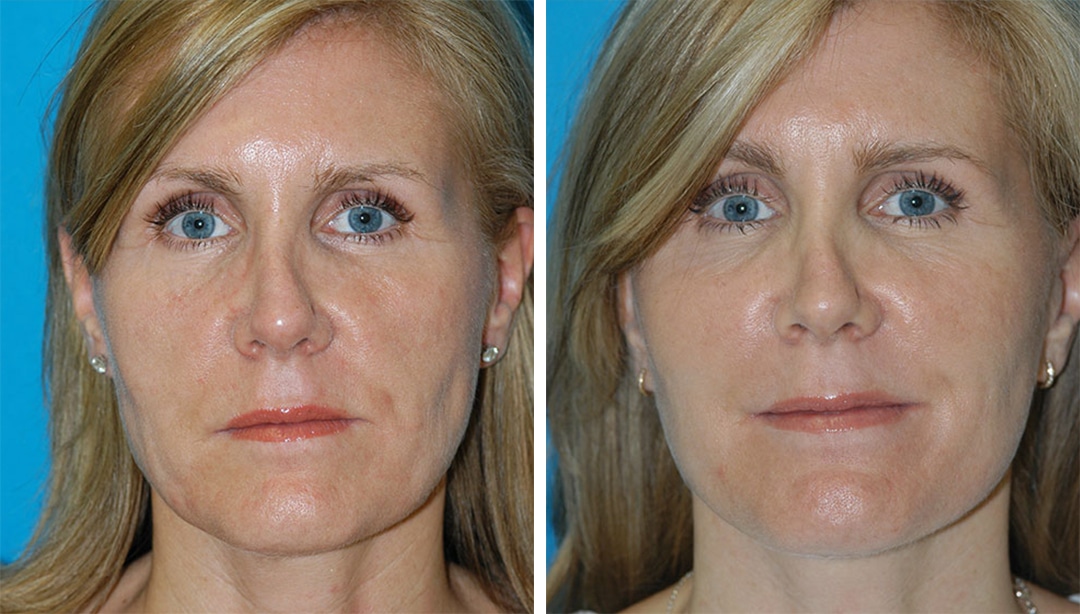
What Is a Mini Facelift?
A mini facelift is a less extensive surgical facelift designed to improve early jowling, mild skin laxity, and reduced definition along the lower face and jawline. Shorter incisions are generally placed around the ear, allowing deeper facial tissues to be lifted and repositioned while excess skin is carefully addressed. Compared with a full facelift, the procedure typically involves less extensive correction and a shorter recovery period.
Mini facelift before and after photos can help illustrate the degree of improvement possible, although results depend on facial anatomy, skin quality, and the amount of laxity present.
What Is the Best Age for a Mini Facelift?
There is no single best age for a mini facelift because candidacy depends more on facial aging than a specific birthday. The procedure is generally most appropriate when early jowls, lower facial laxity, or loss of jawline definition have developed but more extensive aging has not yet occurred.
A mini facelift in your 30s may occasionally be appropriate when early tissue laxity creates visible changes, although surgery at this age should be considered carefully. A mini facelift at 40 years old or during the 40s and 50s may be more appropriate when early jowling and lower facial descent become noticeable.
Mini Facelift vs Full Facelift: What is the Difference?
A mini facelift addresses more limited signs of aging, particularly early changes along the lower face and jawline. It generally uses shorter incisions and involves less extensive tissue repositioning, which can mean a shorter surgical procedure and recovery period.
A full facelift provides more comprehensive correction when sagging, jowls, deeper folds, and neck laxity are more advanced. The right approach depends on the areas that need correction rather than simply choosing the less extensive procedure.
What Is Mini Facelift Recovery Like?
Mini facelift recovery is typically shorter than recovery after a more extensive facelift, with most swelling and bruising improving steadily during the first few weeks.
First Week
Swelling, bruising, and tightness are usually most noticeable during the first several days. Many people can return to work and light daily activities within approximately five to seven days, depending on how they are healing.
First Month
Most visible swelling and bruising continue to improve, and the face begins to look more settled. Exercise and more strenuous activities may gradually resume based on Dr. Brunner’s postoperative guidance.
First Six Months
Residual swelling continues to resolve, and incision lines gradually become less noticeable. The lower face and jawline typically appear more refined as the tissues continue to heal and settle.
One Year
Mini facelift results are generally well established by this point, and scars have had more time to mature and fade. The face will continue to age naturally, but the improvement created by surgery can remain visible for years.
Why Patients Choose Dr. Brunner
Eugenie Brunner, MD, FACS, is a double board-certified facial plastic surgeon whose practice focuses on the face and neck. She completed advanced cosmetic facial plastic surgery fellowship training at the University of Toronto and has served as an attending physician in the Department of Surgery at University Medical Center at Princeton since 1997.
Her experience includes thousands of cosmetic facial plastic procedures, and she has been recognized as a Castle Connolly Top Doctor for more than two decades. She was also named a 2026 New Jersey Monthly Select Surgeon for facelift, facial liposuction, and skin resurfacing.
During a consultation for a mini facelift in Princeton, Dr. Brunner evaluates facial structure, skin laxity, jowling, and neck changes before determining whether a mini or more comprehensive facelift will provide the appropriate correction. The consultation also provides an opportunity to discuss mini facelift recovery, expected results, and the cost of a mini facelift based on the surgical plan.

Mini Facelift FAQ
How Long Does a Facelift Last?
Facelift results can remain visible for many years, although surgery does not stop the natural aging process. Longevity depends on the type of facelift, skin quality, genetics, lifestyle, and how facial tissues continue to change over time. A mini facelift generally provides more limited correction than a comprehensive facelift, so its longevity may also differ.
Does a Mini Facelift Treat Jowls?
Yes. Mild to moderate jowling is one of the primary concerns a mini facelift can improve. The procedure repositions lower facial tissues to create a cleaner transition between the face and jawline. More advanced jowling may require a full facelift for sufficient correction.
Does a Mini Facelift Tighten the Neck?
A mini facelift will create improvement near the jawline and upper neck, depending on the surgical technique and degree of laxity. However, significant loose neck skin or prominent neck bands usually require more extensive treatment. Dr. Brunner evaluates the face and neck together to determine which approach can provide the most appropriate result.
Can a Mini Facelift Improve Marionette Lines?
A mini or lower facelift can soften marionette lines when they are partly caused by descending facial tissues and jowling. By repositioning these tissues, the procedure can reduce heaviness around the corners of the mouth and lower face. Deep lines caused by multiple factors may not disappear completely and may benefit from additional treatment.
How Soon Can I Return to Work?
Many people undergoing a mini facelift can return to work in approximately five to seven days. The exact timing depends on swelling, bruising, the extent of surgery, and whether the job involves strenuous activity. Some people choose additional time before returning to highly visible professional or social settings.
When Do Mini Facelift Scars Fade?
Mini facelift scars gradually become less noticeable as the incisions mature. They are typically positioned around the natural contours of the ear and nearby hairline to make them easier to conceal. Scar appearance continues to improve over several months, and protecting healing incisions from sun exposure can support better scar maturation.
Schedule a Mini Facelift Consultation in Princeton, NJ
Dr. Brunner and her staff will be happy to discuss a mini facelift with you. When you come in for your consultation, Dr. Brunner will formulate the best mini facelift treatment plan to suit your specific needs. Please contact us online or call our Princeton, NJ office (609) 921-9497 to schedule your private consultation.
Next, Read About…

Blepharoplasty
An eyelid lift or blepharoplasty can correct these issues and remove the puffiness and bags under the eyes that make you look worn and tired.

Rhinoplasty
Rhinoplasty (a type of nasal surgery), also referred to as “nose reshaping” or a “nose job,” improves the appearance and proportion of your nose, enhancing facial harmony and self confidence.

Fraxel Re:Pair
The Fraxel Re:pair laser is a non-surgical enhancement that is the premier fractional ablative CO2 laser designed for treatment of wrinkles, sun damaged skin, texture irregularities, acne scarring, brown spots due to sun exposure and aging, and generalized redness.